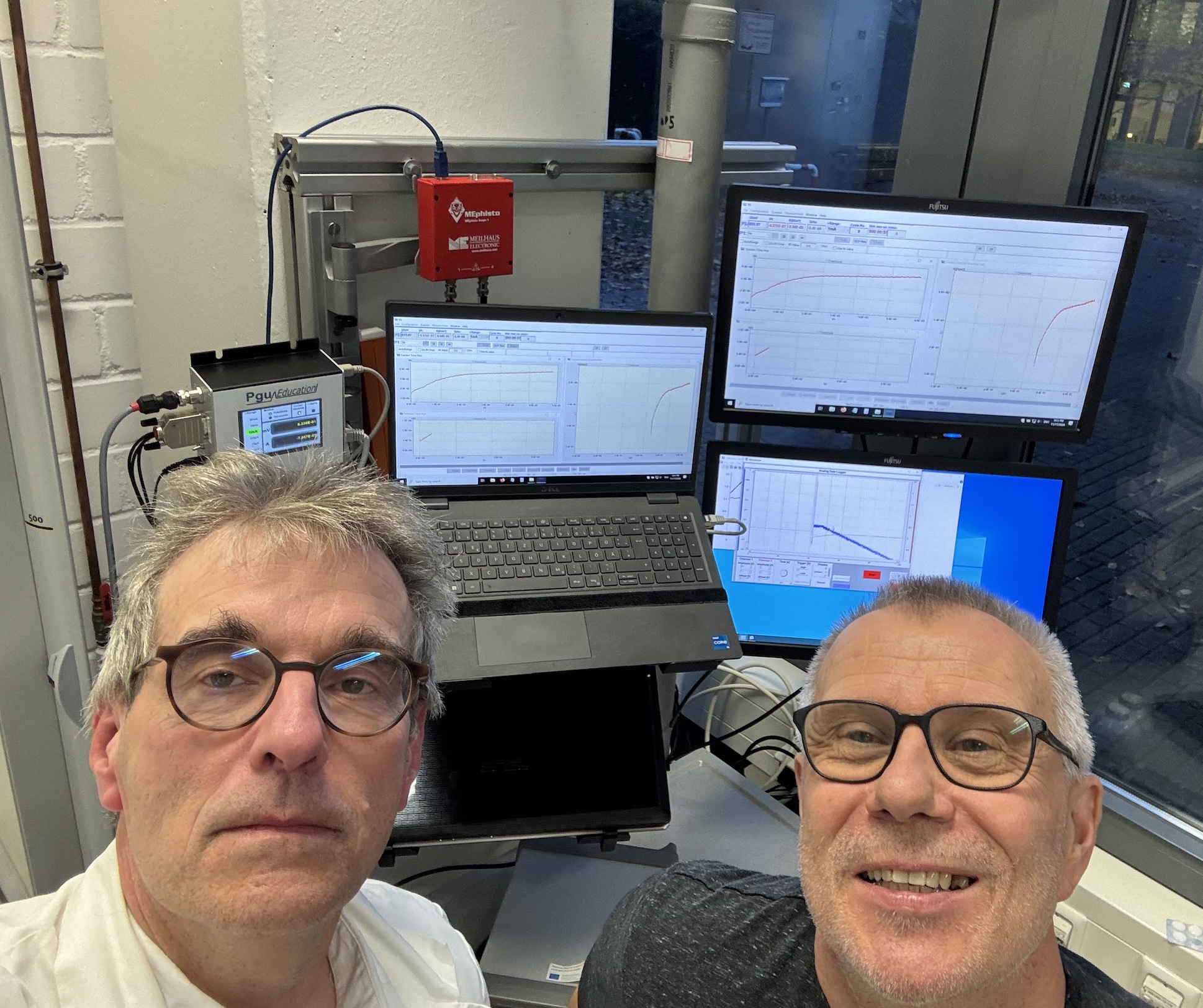
IPS Elektroniklabor
PguEducation im Praktikum der Physikalischen Chemie, November 2026.
Deutsch
Im November 2026 hat IPS Elektroniklabor GmbH & Co. KG (IPS) den Potentiostaten PguEducation in der Physikalischen Chemie auf dem Campus Essen vorgeführt. Die Zusammenarbeit läuft mit Peter Schrems persönlich.
Zwei Aufgaben stehen dahinter. Das Praktikum soll mit günstigeren Geräten ausgestattet werden, damit mehr Studierende elektrochemisch selbst messen können. Daneben laufen Industrieprojekte, die technisch anspruchsvoll sind und um denselben Prozess kreisen.
Für diese Anforderungen hat IPS am PguEducation einen D-Sub-Anschluss ergänzt. Potential und Strom lassen sich darüber unabhängig mit einem Multimeter oder einem Oszilloskop aufnehmen. Ein externer Sollwerteingang nimmt ein zusätzliches Gleich- oder Wechselspannungssignal auf.
Vor Ort wurde ein schnelles Cyclovoltammogramm in EcmWin programmiert, in den Potentiostaten geladen und gestartet. Parallel hat ein Meilhaus-Oszilloskop die Signale an den externen Ausgängen mitgeschrieben. Der Test war erfolgreich. Studierende können die Anzeige am Rechner und am Gerät mit einer zweiten, unabhängigen Messung prüfen. Dieselbe Eigenschaft ist für zertifizierte Industrieprozesse nötig. Weitere PguEducation-Geräte sind für die Universität vorgesehen.
Darin liegt ein großer Vorteil. Potential und Strom des Potentiostaten lassen sich mit einem externen Oszilloskop prüfen, zum Beispiel mit einem USB-Oszilloskop der Firma Meilhaus. Für die Lehre kommt ein zweiter Gewinn dazu: Im Praktikum lässt sich neben der Elektrochemie auch der Umgang mit einem USB-Oszilloskop vermitteln.
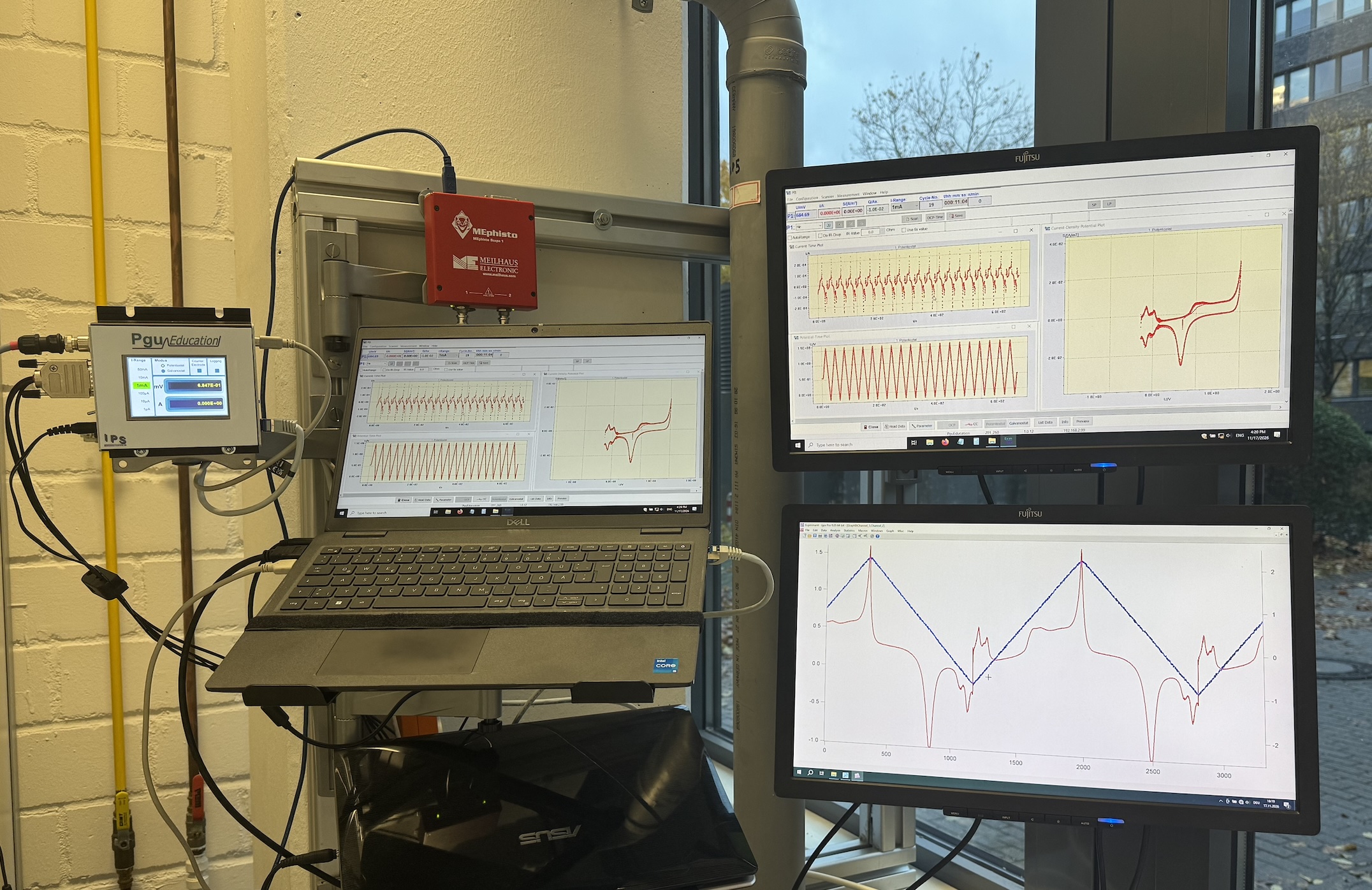
Für Diesings Anforderungen haben wir einen eigenen D-Sub-Anschluss ergänzt. Er gibt Potential und Strom aus, sodass sie unabhängig mit einem Multimeter oder einem Oszilloskop (wie hier von Meilhaus) aufgezeichnet werden können.
IPS Elektroniklabor GmbH & Co. KG, LinkedIn, November 2026. Der Beitrag ist öffentlich lesbar. Das Porträt oben stammt aus diesem Beitrag.
English
In November 2026, IPS Elektroniklabor demonstrated the PguEducation potentiostat in the Physical Chemistry group on the Essen campus. The cooperation is with Peter Schrems and the engineering office IPS Elektroniklabor.
Two tasks sit behind the visit. The teaching lab is to be equipped with more affordable instruments, so that more students can measure electrochemistry themselves. Alongside that, the industry projects are technically demanding and always concern the same process.
For these requirements, IPS added a D-sub connector to the PguEducation. Potential and current can be recorded independently with a multimeter or an oscilloscope. An external setpoint input accepts an additional DC or AC signal.
On site, a fast cyclic voltammogram was programmed in EcmWin, loaded into the potentiostat, and started. A Meilhaus oscilloscope recorded the signals at the external outputs in parallel. The test succeeded. Students can check the values on the computer and on the instrument with a second, independent measurement. The same feature is needed for certified industrial processes. Further PguEducation units are planned for the university.
That is a real advantage. Potential and current from the potentiostat can be checked with an external oscilloscope, for example a USB oscilloscope from Meilhaus. The photograph above shows the same measurement on the computer and on the oscilloscope. Teaching gains something further: the lab course can also teach students how to use a USB oscilloscope.
For Diesing's requirements, we added a dedicated D-sub connector. It outputs potential and current so they can be recorded independently with a multimeter or an oscilloscope.
IPS Elektroniklabor GmbH & Co. KG, LinkedIn, November 2026. The post can be read without a LinkedIn account. The portrait above is from this post.